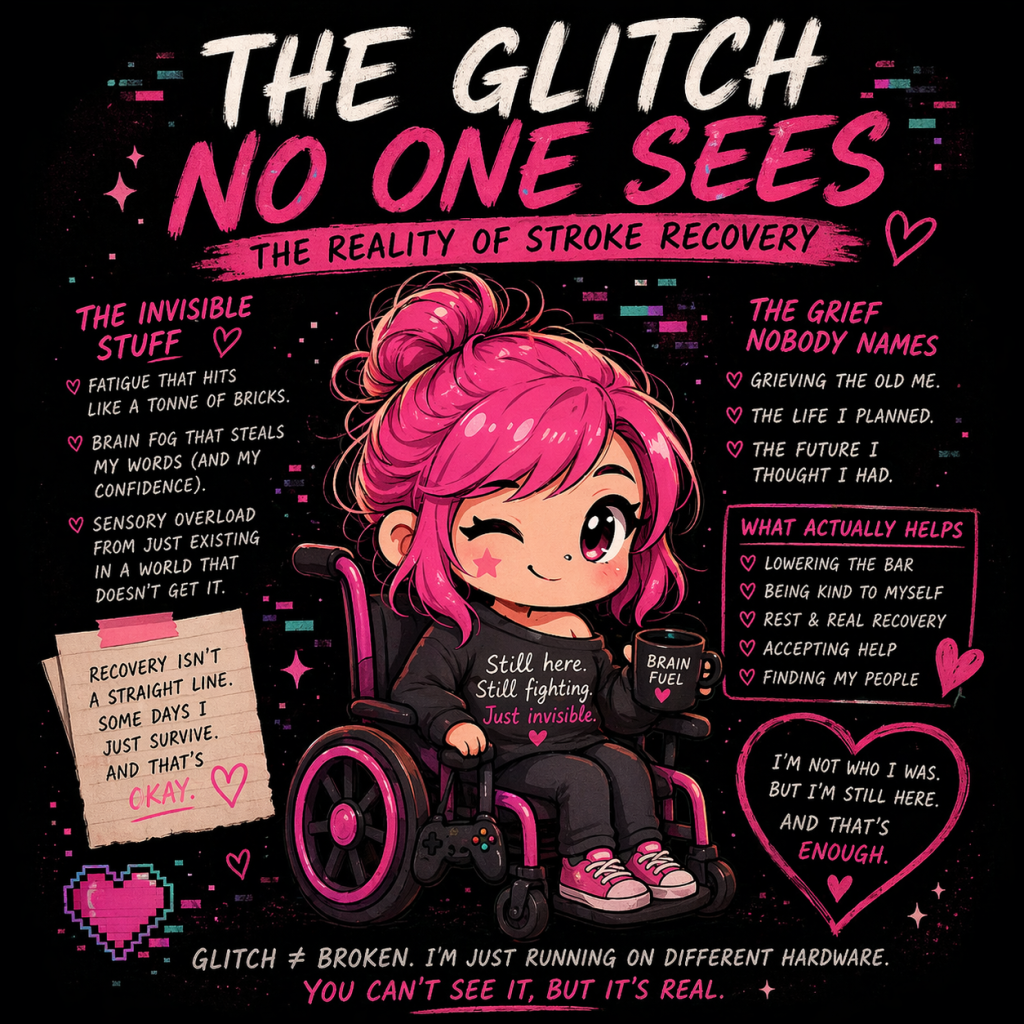
What stroke recovery actually feels like – the real version. Not the inspiration poster version. The actual one.
There’s a version of stroke recovery that gets shown to the world. The one where someone relearns to walk, hugs their family, and cries at a graduation ceremony while an uplifting piano track swells in the background.
That’s not what I’m here to write about.
I’m here to write about the other version. The one nobody warns you about. The version that happens when you’re standing in your bedroom holding your trousers, and you genuinely cannot remember how to put them on. You just stand there. Staring. And then you cry – not because of the trousers, not because of one specific thing, but because everything is so hard now, and your body just needs to release it somehow, and it comes out as tears in the middle of getting dressed on a Tuesday.
That’s stroke recovery. The version nobody films.
“Recovery isn’t a straight line. It’s a corrupted save file that sometimes loads fine and sometimes doesn’t load at all.”
The invisible side of stroke recovery
The thing nobody gets – and I mean nobody, not even some of the people who love you most – is how much of stroke recovery is completely invisible.
You look fine. You might even seem fine. You got dressed, you replied to a text, you made a cup of tea. And so people assume you’re fine. What they don’t see is that those three things took everything you had, and now you need to lie down for two hours..
This is called fatigue, and it is nothing like being tired. Being tired is a low battery notification. Post-stroke fatigue is your whole operating system shutting down mid-task with zero warning.
And then there’s the sensory stuff. Crowds. Noise. Busy places. Things you used to love – I used to go dancing, properly out dancing, clubs, loud music, the whole thing – and now the same environment that used to feel like freedom can feel like an attack on your entire nervous system. That’s not weakness. That’s your brain telling you it’s working at capacity and it cannot process any more input right now.
- Brain fog that makes you feel like you’re thinking through wet concrete — even on good days.
- Word-finding issues that hit without warning, mid-sentence, usually when you’re already anxious.
- Emotional dysregulation – your brain’s filter is literally broken. You might cry at an advert. You might feel nothing at something huge. Both are valid. Both are neurological.
- Sensitivity to noise, light, and crowds that used to be fine and now genuinely hurt.
- Memory glitches – you remember some things perfectly and other things just… don’t exist.
Real talk
None of this means your brain is broken beyond repair. It means it was injured and it is working incredibly hard to rewire itself. Neuroplasticity is real. Recovery is non-linear. A bad week doesn’t erase a good one. Your brain is doing something extraordinary — it’s just not doing it in a way that looks like the posters.
The grief after stroke nobody talks about
There’s a grief that comes with brain injury that doesn’t get a sympathy card. You’re not grieving a death. You’re grieving a version of yourself. The one who could multitask. The one who could follow a fast conversation. The one who didn’t need to write everything down immediately or it would vanish.
That grief is real. You’re allowed to feel it. You’re allowed to be angry about it. You’re also allowed to, somewhere down the line, build something new with whatever version of your brain you have now. Those two things can be true at the same time.
“You are not a lesser version of who you were. You are a different version, running on different hardware, still here.”
What actually helps during stroke recovery
Not in a “have you tried mindfulness” way. In a real, practical, I’ve-been-in-the-thick-of-it way.
- Lowering the bar — and actually meaning it, not just saying it. If you got out of bed, you did something.
- Telling people specifically what you need rather than hoping they’ll figure it out. They won’t. They can’t read the glitch.
- Learning the difference between a bad day and a bad period. One doesn’t mean the other.
- Rest that isn’t tinged with guilt. Rest is medicine. It is not laziness.
- Accepting that aids exist to help you — and using them is not giving up. A wheelchair. A jar opener. Earplugs. A grabber. A pill organiser. These things are not admissions of failure. They are tools that give you your life back, even partially, even differently. You wouldn’t call glasses “giving up on seeing.”
- Finding other people who get it — not to wallow, but because being understood is genuinely therapeutic.
A genuine win
I used to go clubbing. Loud music, packed rooms, late nights – I loved it. That version of a night out isn’t accessible to me in the same way anymore, and that took time to grieve. But I found a daytime disco – earlier, calmer, still with all the music and joy – and I wear my Loop earplugs so the sound doesn’t overwhelm me. Is it the same? No. Is it still dancing? Absolutely yes. That’s not settling. That’s adapting. And sometimes adapting looks really, really good.
If you found this because you’re in the middle of it right now – I see you. The glitch no one sees is still a glitch that’s really happening. Your experience is valid even when it’s invisible to everyone else.
And if you found this because someone you love is going through it — please, please believe them when they say they’re struggling. You might not be able to see it. That’s exactly the point.
Glitch ≠ broken. You’re still here, and that’s not nothing. That’s everything.