
Here's something that'll make your blood boil. Disabled and chronically ill people in the UK already face a financial triple-whammy: higher rates of economic inactivity, a disability pay gap, and an average of £975 extra per month in costs just to have the same standard of living as non-disabled people. PIP is supposed to help bridge that gap. It falls at least £200 short, every single month, according to Scope.
So you'd think that companies designing products specifically for disabled and chronically ill people would, I don't know, price them accordingly?
You'd think wrong.
VISIBLE 2.0
Visible is a heart rate monitor armband designed specifically for pacing – and they'll tell you that themselves. Long Covid, ME/CFS, Fibromyalgia, POTS, EDS: it's all right there on the homepage. This is not a fitness tracker for gym bros. This is a medical tool for people whose bodies are actively working against them.
The device tracks second-by-second heart rate data and uses it to calculate two things: PacePoints (your overall exertion score, basically your energy budget) and Morning Stability (how much energy you've actually got that day). For those of us who have zero internal awareness that we're crashing until we're already flat on the floor – this kind of data is genuinely life-changing.
I know this because I used it. While I was still employed. It helped. A lot. Standing up sends my heart rate through the roof and I had no idea until Visible told me. Those reminders to slow down, to check in, to respect your own limits? Useful. Actually useful.
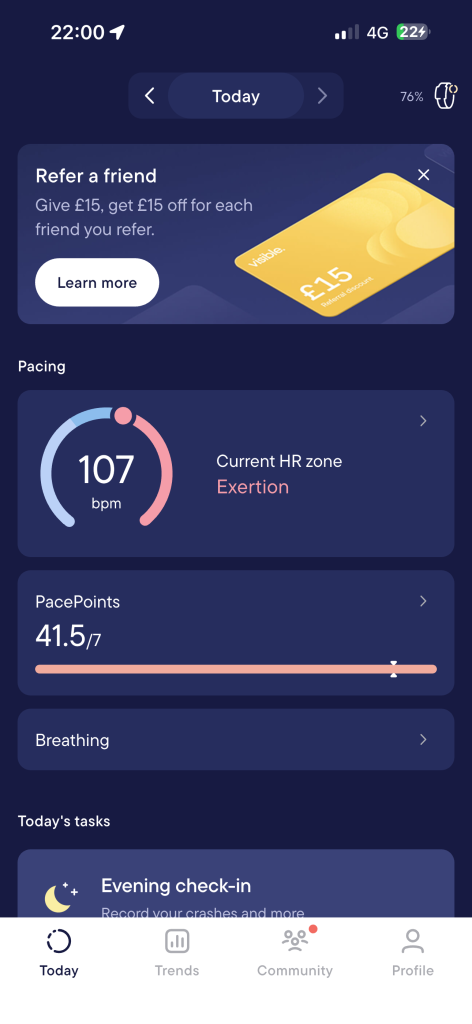
So let's talk about what it costs.
Go for the annual plan: £49.70 for the device (half price, ooh, a treat) plus £10.99 a month – £181.58 total for year one. Monthly plan? £84.70 for the device plus £14.99 a month. Nearly £100 before you've even used it once. Oh, and need an XL armband, or the new wristband option? That's another £12.99-£24.99, because apparently one size fits most and most isn't you.
Now here's where it gets genuinely grim. Stop paying the subscription? The device becomes a very expensive brick. There is a free tier – but it pulls zero data from the armband. You can log check-ins and poke your phone camera at your finger for a heart rate reading, but that's your lot. The wearable you paid nearly £85 for? Decorative.
They do mention future NHS availability. They're “building the evidence base.” Great! Except the evidence base is being built on the backs of the very community who can least afford it. The people who need Visible most – the most severely affected, the most economically precarious – are the ones being priced out.
Visible is UK and US registered and is backed by multiple venture capital firms. Make of that what you will.
(They also have a refer-a-friend scheme, which is probably why your favourite chronic illness creator is suddenly very enthusiastic about pacing tech. Just saying.)
HILO
Hilo has been living rent-free in my social media feed, and I'll be honest – I got curious. It's a wristband that takes regular blood pressure readings. As someone in perimenopause (higher stroke risk), and someone who has actually had a haemorrhagic stroke (very much would prefer not to repeat that), continuous BP monitoring sounds like exactly the kind of thing that could matter.
The tech is genuinely interesting: you calibrate with a cuff, then the wearable takes readings whenever you're still. The cuff is used occasionally to recalibrate the wearable. Their CE mark is recent and a big deal – it means it's medically validated, not just wellness-flavoured guesswork.
Cost: £199.98 for the first year. £119.99 every year after that.
And yes, same story – stop paying, the band stops working. You get 30 days of limited access, then it's done. You do get to keep the band and cuff though. Thanks. Incredibly useful paperweight, cheers.
Hilo is owned by Aktiia, which has raised over $100 million in venture capital funding. Their About Us page reads less like a health company and more like a VC portfolio highlight reel. Which tells you everything about who this product is really built for – and it's not us.
SO WHAT'S ACTUALLY GOING ON HERE?
These aren't fitness gadgets. These are medical-adjacent tools designed for people managing serious, life-limiting conditions – and they're being sold at price points that actively exclude the people who need them most.
But here's the thing. People are buying them. People like me, who stretched their budget, who justified the cost because when you are that ill and that desperate for something that might help, you will find a way. And venture capitalists know this. They don't back products out of the goodness of their hearts – they back quantified data. They back proof that people will pay. And disabled and chronically ill people, against all financial logic, are proving it every single month.
So let's be clear about what's actually happening. We are paying subscription fees to fund the evidence base that will eventually make these companies enormously profitable. We are handing over our most intimate health data – our heart rates, our blood pressure, our crash patterns, our worst days – to VC-backed companies whose primary obligation is to their investors, not to us. And in return, we get a device that stops working the moment we can't afford to keep up.
That is not a wellness product. That is a data extraction business with a chronic illness paint job.
We are not a niche. We are not an edge case. There are approximately 16 million disabled people in the UK. We are a market – and we are being mined.
The NHS needs to move faster on integrating validated tools like these. Charities, grant programmes, and access schemes need to exist before the VC money is already locked in. And we – the disabled and chronically ill community – need to call this out every single time we see it.
Because a tool that could change your life, but that you can't afford to keep? Isn't a tool. It's a trap.
Glitch ≠ broken. But this system? Absolutely is.
One comment